Dental Implant Cost: Price Ranges and What Affects Them
Dental implant cost depends on how many teeth you are replacing, your bone health, and the materials used. Here is what to expect before you book.
Planning to replace a missing tooth or an entire arch raises one question right away: what will it cost? If you are researching dental implant cost, you will find there is no single price. Your total depends on how many teeth you are replacing, the condition of your jawbone, the materials chosen, and whether any preparatory treatment is needed first. This guide explains typical price ranges, what drives the numbers up or down, and practical ways to make treatment more affordable without sacrificing quality.
What Is the Average Dental Implant Cost?
Implant pricing is built from several parts, and each reflects a different stage of care. For a single tooth, many practices across the United States quote roughly $3,000 to $4,500, which typically covers the titanium or zirconia post, the abutment that connects the post to the tooth, and the final crown. Larger cases cost more because they involve more implants and more complex restorations. The ranges below are general estimates only. Your exact fee is confirmed after an exam and imaging.
| Treatment | Typical Estimated Range | What It Usually Includes |
|---|---|---|
| Single tooth implant | $3,000 to $4,500 per tooth | Implant post, abutment, and crown |
| Implant-supported removable denture | $20,000 to $45,000 per arch | Several implants plus a denture that snaps into place |
| Fixed full arch of teeth | $50,000 to $90,000 per arch | Four to eight implants and a permanently attached set of teeth |
These figures can look high at first glance, but implants are built to last for decades with good care. They also replace the root of the tooth, which keeps the jawbone stimulated and supports a stable bite. To see how the full process unfolds from consultation to final restoration, read the step-by-step implant placement overview.
What Is Included in a Single Implant Fee
A single implant has three components. The post is placed in the jaw and acts as an artificial root. The abutment is a small connector that attaches to the post. The crown is the visible tooth, usually made of porcelain or an advanced ceramic. Some offices bundle all three into one fee, while others price each part separately, so always ask for a written breakdown. If you want to understand how the visible part of your restoration is designed, learn about custom crown restorations and how they are matched to your natural teeth.
Factors That Affect Implant Pricing
Two patients can both receive an implant and still pay different amounts. Knowing what influences the estimate helps you compare quotes fairly and avoid surprises.
How Your Treatment Plan Shapes Dental Implant Cost
Every plan is built around your mouth, your goals, and your health history. The factors below explain most of the variation from one patient to the next.
Implant and Crown Materials
Implant posts are made from medical-grade titanium or zirconia. Titanium is the most widely used and has the longest research record. Zirconia is a metal-free option that some patients prefer for cosmetic reasons or because of metal sensitivity. Crown materials matter too. Porcelain offers a natural look and good durability, while premium ceramics can raise the price. Quality materials support long-term stability and lower the chance of complications.
Number of Teeth Being Replaced
One missing tooth calls for one implant and one crown. Several missing teeth may need multiple implants or an implant-supported bridge. Each implant requires careful placement and healing time, so the count of implants has a direct effect on the total. Full arch cases generally use four to eight implants per arch, depending on the style of restoration.
Location of the Missing Tooth
Front teeth demand extra planning because they are so visible. The angle of the implant, the contour of the gum tissue, and the shape of the crown all need fine adjustment to create a seamless smile. Back teeth carry heavier chewing forces, which affects the design and strength requirements. Either location can influence the final fee.
Bone Grafting and Preparatory Procedures
An implant needs enough healthy bone to hold it securely. When bone has thinned after tooth loss, a graft can rebuild the area before placement. Bone grafting before implant placement adds time and cost depending on the size of the graft. Patients in the upper back jaw may also need a sinus augmentation to create room for the implant. If a damaged tooth is still in place, removal of damaged teeth may be the first step. These extras raise the initial investment, yet they greatly improve long-term success.
Imaging Technology and Provider Experience
3D cone beam CT scans let a dentist map nerves, sinuses, and bone density before surgery. That precision leads to safer, more predictable placement. Training and hands-on experience matter just as much, since implant care blends surgical skill with restorative design. A more experienced provider may charge more up front, but a smoother process and fewer corrective visits often balance the difference.
Regional Overhead
Fees vary by area because office costs, staffing, and available technology differ. A practice that invests in advanced equipment and a skilled team will price accordingly. Rather than choosing on the lowest quote alone, compare what each estimate includes.
Single Tooth vs Full Mouth Implant Pricing
Many patients assume full mouth treatment must cost far more per tooth than a single implant. The total is certainly higher, but the cost per tooth is often lower. Full arch designs rely on a limited number of strategically placed implants to support an entire set of teeth. A patient replacing every upper tooth may need only four to six implants rather than one for each missing tooth. That approach shortens surgical time and reduces material use while still delivering a fully functional smile.
| Factor | Single Tooth Implant | Full Arch Implants |
|---|---|---|
| Implants needed | One per missing tooth | Typically four to eight per arch |
| Total investment | Lower overall | Higher overall |
| Cost per replaced tooth | Higher | Often lower |
| Best suited for | One or two isolated gaps | Most or all teeth missing in an arch |
| Replaces | A single natural tooth | Traditional dentures |
If you are missing a single tooth or a few teeth, see how replacing individual gaps works. If an entire arch is affected, learn about full arch tooth replacement. Patients who prefer a removable option anchored by implants can explore implant-supported denture solutions, and the snap-in denture approach offers added stability over conventional dentures.
Why Replacing Missing Teeth Matters
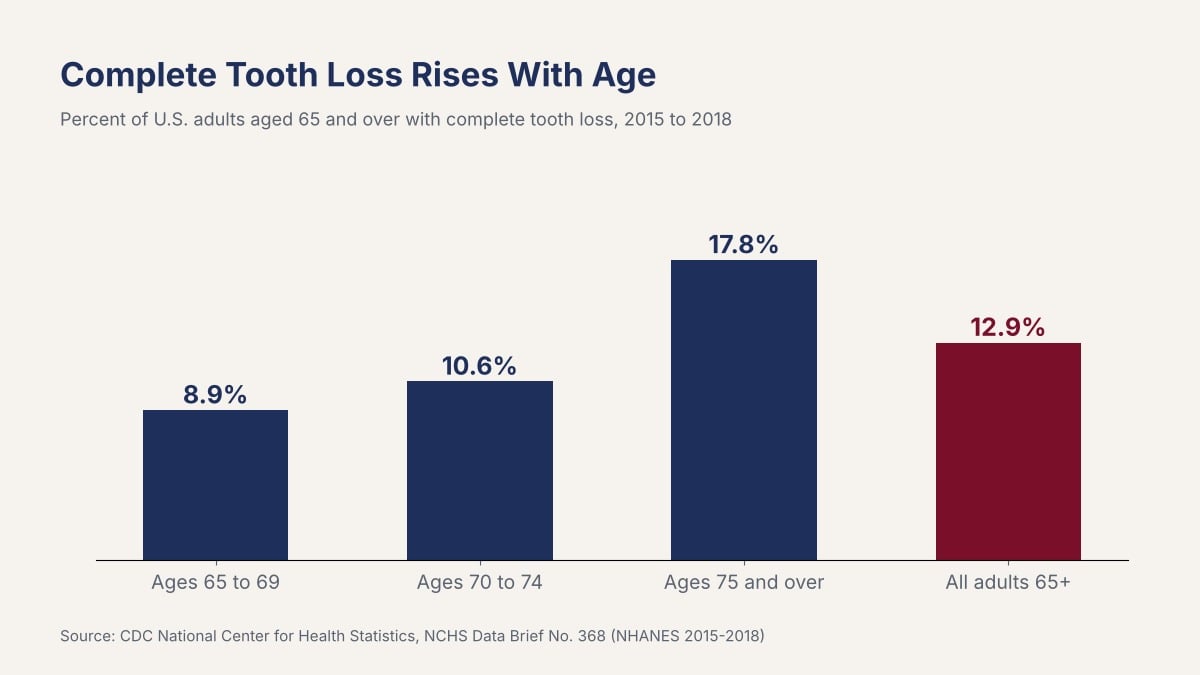
Tooth loss is not just a cosmetic concern. According to the Centers for Disease Control and Prevention, complete tooth loss can limit food choices and make social interaction harder. National data show that the problem becomes more common with age, and that rates differ by household income.
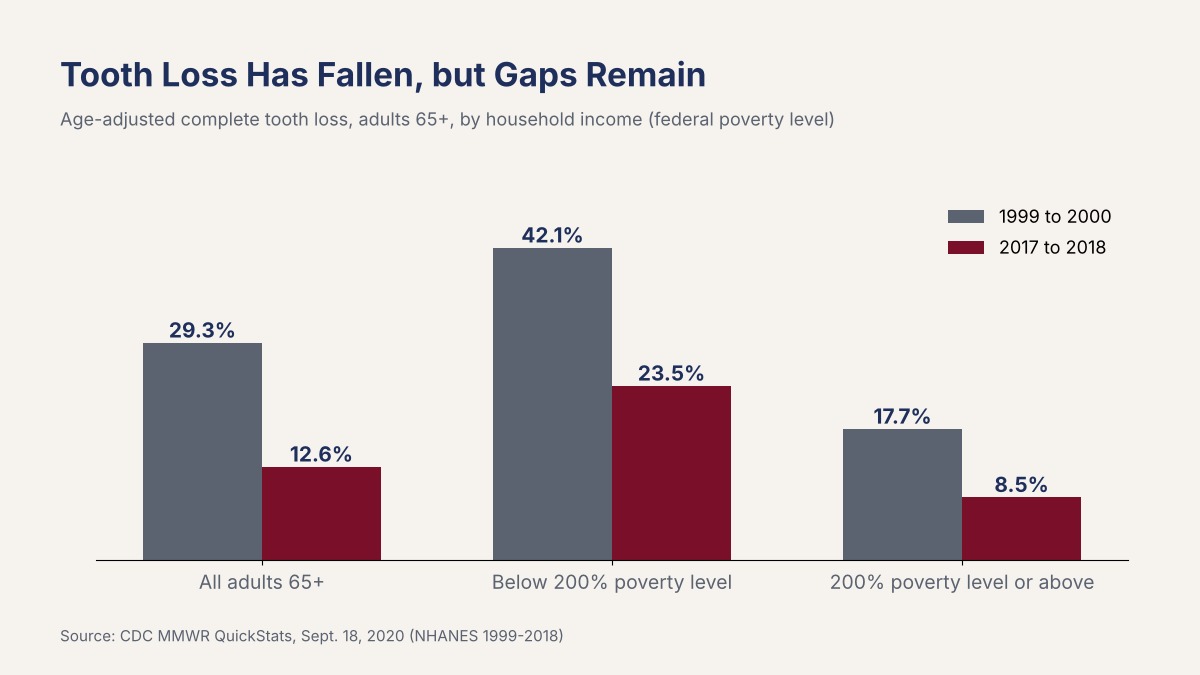
The CDC also reports that the share of older adults with complete tooth loss fell sharply over two decades. That improvement reflects better prevention and restorative care. Even so, adults in lower-income households still lose teeth at roughly three times the rate of higher-income households in the most recent data, which shows how much access to care matters.
Replacing a missing tooth early protects the surrounding teeth from shifting and helps preserve the bone that holds them in place. That is a major reason many patients view implant cost as an investment in function rather than a one-time expense.
Implants Compared With Dentures and Bridges
Implants usually require a larger upfront payment than other replacement options, but the long-term picture is different. Removable appliances often need adjustment or replacement every five to eight years, and bridges depend on neighboring teeth that can weaken over time. An implant integrates with the jawbone and functions like a natural root.
| Feature | Dental Implant | Bridge | Removable Denture |
|---|---|---|---|
| Upfront cost | Highest | Moderate | Lowest |
| Protects jawbone | Yes | No | No |
| Needs neighboring teeth altered | No | Yes | Sometimes |
| Adhesives needed | No | No | Often |
| Typical replacement cycle | Long-term with care | Periodic replacement | Every five to eight years |
If you want to compare options side by side, review fixed bridgework and removable tooth replacement before deciding. Because implants preserve bone and require no adhesives, patients can eat a full range of foods with confidence. Many describe a lasting boost in comfort, speech, and self-assurance, which is why the long-term value often outweighs the higher starting price.
How to Make Implant Treatment More Affordable
A larger investment does not have to mean an unmanageable one. Most patients combine a few of the strategies below.
Insurance Coverage for Implants
Coverage varies widely. Some plans help with the crown or part of the surgical placement, while others exclude implants entirely. Partial coverage still reduces what you pay out of pocket. Our team can review your plan with you, and you can read about dental benefits and coverage guidance before your visit.
Payment Plans and Financing
Many patients spread the cost of treatment over several months or years. Third-party financing companies often provide low-interest or interest-free options, which let you start care now instead of delaying it. Review the office’s payment and financing details to see what fits your budget.
Introductory Savings for New Patients
Some savings apply to the first visit, such as reduced-fee exams and imaging. Check current new patient offers to see what is available when you schedule.
Staging Treatment Over Time
If a full plan feels like too much at once, your dentist may be able to divide it into phases. Urgent needs such as infection control or extractions come first, followed by grafting, implant placement, and final restorations. Phasing spreads out payments and gives tissues time to heal between steps.
What to Expect at an Implant Consultation
A consultation is where a rough range becomes a firm number. Knowing the process helps you arrive prepared.
- Medical and dental history review. Your dentist asks about health conditions, medications, and past dental work, since these affect healing and candidacy.
- Clinical exam and 3D imaging. Scans reveal bone volume, nerve location, and sinus position so the surgery can be planned precisely.
- Treatment plan and written estimate. You receive a recommended sequence of care with itemized fees for each stage.
- Benefits and payment review. The team explains what insurance may cover and which payment options are available.
- Comfort planning. Patients who feel anxious can discuss relaxation and sedation choices before surgery day.
New to the office? The first visit walkthrough explains what to bring and how the appointment is organized.
Choosing an Experienced Implant Provider
Choosing an experienced provider is one of the best ways to protect your investment. A & A Family Dentistry offers general, cosmetic, and restorative care for the whole family, including porcelain veneers, crowns, bridges, and implant services. Dr. Ardalan focuses on precise, compassionate care and can help you redesign your smile with a plan that fits your goals. To explore every available implant dentistry option or to get a personalized estimate, reach out to our team today.
Frequently Asked Questions About Implant Costs
How much does a single dental implant cost?
Many practices quote roughly $3,000 to $4,500 per tooth, which commonly covers the implant post, abutment, and crown. Bone grafting, extractions, or sinus procedures are additional when needed. A written estimate after your exam gives the most accurate figure.
Why do full mouth implants cost so much?
Full arch treatment involves several implants, detailed imaging, surgical planning, and a custom set of teeth. The total is higher, but the cost per tooth is often lower than replacing each tooth individually.
Does dental insurance cover implants?
It depends on the plan. Some policies cover the crown or part of the surgery, while others offer no implant benefits. The office team can review your plan and explain what may apply.
Are there payment plans for implant treatment?
Yes. Many patients use financing to divide the cost into manageable payments over several months or years. Some third-party options offer low-interest or interest-free terms, depending on approval.
Do I need a bone graft before getting an implant?
Not everyone does. If your jawbone is too thin or soft to hold an implant securely, a graft can rebuild it first. Your dentist will assess this with a clinical exam and 3D imaging.
Are dental implants worth the higher price?
For many patients, yes. Implants replace the tooth root, help preserve jawbone, and do not rely on neighboring teeth or adhesives. With good care they are designed to last many years, which can reduce the need for repeat replacements.
How long does implant treatment take?
Timelines vary. A straightforward case can take several months because the implant needs time to bond with the bone. Cases that include grafting or extractions take longer.

